
Introduction
Affiliate Disclosure: This post may contain affiliate links. It means, I may earn a commission at no extra cost to you if you make a purchase through them.
Asset tokenization is rapidly becoming one of the most transformative innovations in modern finance. As blockchain technology evolves beyond crypto currencies like Bitcoin and Solana, investors, financial institutions, and governments are increasingly exploring how real-world assets can be represented digitally on decentralized networks. From real estate and stocks to gold, artwork, and intellectual property, tokenization is changing how ownership is created, traded, and transferred in the global economy.
The rise of blockchain-based tokenization is closely tied to growing interest in decentralized finance, digital investment platforms, and alternative wealth-building opportunities. Today, tokenized assets are already attracting institutional giants such as BlackRock, J.P. Morgan, and Franklin Templeton, signaling that tokenization may become a core pillar of future financial systems.
What Is Asset Tokenization?
Asset tokenization refers to the process of converting ownership rights of a real-world or digital asset into digital tokens stored on a blockchain. These tokens act as programmable representations of ownership and can be transferred, traded, or divided into smaller fractions without relying heavily on traditional intermediaries.
In simple terms, tokenization of assets transforms physical or financial wealth into blockchain-based digital assets that investors can buy and sell online. Instead of purchasing an entire property or expensive artwork, investors can own fractions of those assets through tokens.
For example, a $1 million commercial building could be divided into 1 million blockchain tokens worth $1 each. Investors from anywhere in the world could then purchase small portions of the property, enabling fractional ownership and broader accessibility.
Blockchain technology plays a critical role in this process because it provides transparency, immutability, security, and decentralized verification of ownership records. Once ownership information is recorded on a blockchain, it becomes extremely difficult to manipulate or falsify.
Types of Assets That Can Be Tokenized
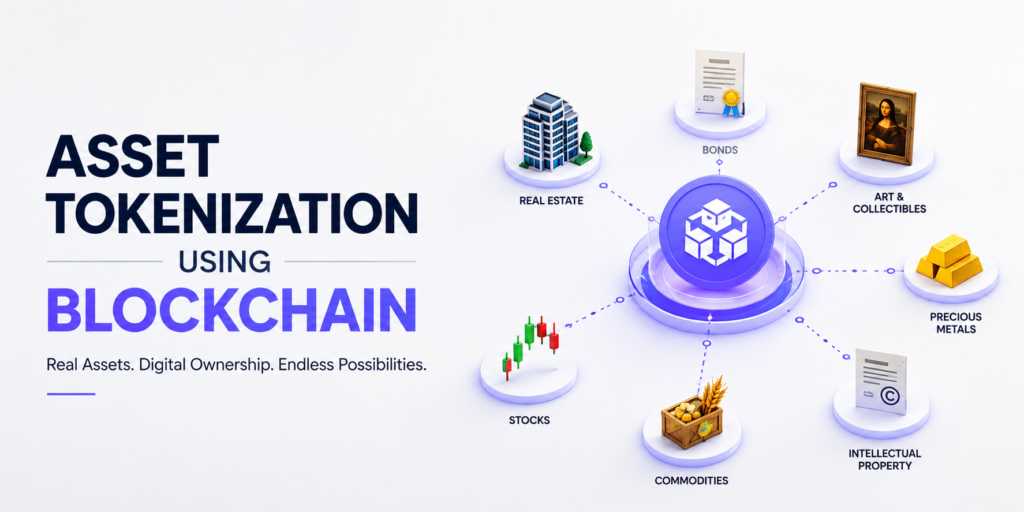
One of the most powerful aspects of blockchain tokenization is its flexibility. Nearly any asset with measurable value can potentially be tokenized.
Real estate is among the most popular examples. Residential homes, commercial buildings, rental apartments, hotels, and land can all be divided into digital ownership shares. Tokenized real estate allows smaller investors to access property markets that were traditionally reserved for wealthy individuals and institutions.
Financial assets such as stocks, bonds, treasury bills, and private equity are also increasingly being tokenized. Large institutions are already experimenting with tokenized treasury funds and digital securities to improve settlement efficiency and global accessibility.
Precious metals including gold and silver are another rapidly growing category. Gold-backed tokens represent ownership of physical gold stored in vaults, enabling investors to trade gold digitally without transporting or storing the physical metal themselves.
Other tokenizable assets include:
- Artwork and collectibles
- Music royalties
- Intellectual property
- Commodities
- Luxury watches
- Carbon credits
- Agricultural products
- Infrastructure projects
- Patents and trademarks
As blockchain adoption expands, tokenization is expected to spread into virtually every sector of the global economy.
How Tokenization of Assets Works on Blockchain Networks
The tokenization process typically begins with identifying an underlying asset and legally structuring ownership rights. A company or issuer then creates digital tokens representing shares or rights associated with that asset.
Smart contracts are commonly used to automate ownership management, dividend distributions, transfers, and compliance procedures. These smart contracts are self-executing programs stored on the blockchain.
For example, on Solana, developers can create tokenized assets using Solana’s high-speed smart contract infrastructure. Solana is attractive because it supports fast transactions and low fees, making it suitable for high-volume tokenized asset trading.
On the XRP Ledger, tokenized assets are often focused on payments, settlement systems, and institutional finance. XRP Ledger is designed for rapid cross-border transactions and low-cost transfers, making it appealing for financial institutions exploring tokenized securities and payment infrastructure.
Meanwhile, networks like Ethereum remain popular due to their mature smart contract ecosystems and widespread developer adoption, although higher transaction costs can become a challenge during periods of heavy network activity.
Why Blockchain Choice Matters in Asset Tokenization
Not all blockchains are equally suitable for tokenization. The choice of blockchain can significantly affect transaction costs, scalability, speed, security, compliance, and user experience.
Transaction fees are extremely important. High blockchain fees can make small-value tokenized transactions impractical. For example, if an investor wants to purchase $20 worth of tokenized real estate but pays $15 in network fees, the system becomes inefficient.
This is why low-cost blockchains such as Solana and XRP Ledger are gaining attention for tokenization projects. Their low fees make micro-investments and high-frequency trading more economically viable.
Transaction speed also matters significantly. Financial institutions and investors increasingly expect near-instant settlement. Traditional stock settlements can take several days, while blockchain systems can settle transactions within seconds or minutes.
Solana is particularly known for high throughput and scalability. Some reports estimate Solana can theoretically process tens of thousands of transactions per second, making it one of the fastest major blockchain networks.
However, speed alone is not enough. Security and decentralization remain critical considerations. Networks prioritizing extreme speed may sacrifice some decentralization, potentially increasing centralization risks.
Regulatory compatibility is another major factor. Institutional investors often prefer blockchains capable of supporting compliance tools such as Know Your Customer (KYC), Anti-Money Laundering (AML), and permissioned trading systems.
Some private or permissioned blockchains are specifically designed for enterprise tokenization because they provide stronger control over participant access and regulatory oversight. According to industry research, permissioned blockchains currently dominate large-scale institutional tokenization initiatives.
Benefits of Asset Tokenization
Asset tokenization offers several important advantages over traditional financial systems.
One of the biggest benefits is fractional ownership. Investors no longer need massive amounts of capital to participate in expensive asset markets. Instead, tokenization allows assets to be divided into affordable digital shares.
Liquidity is another major advantage. Traditionally illiquid assets such as commercial real estate or fine art can become easier to trade on blockchain-based marketplaces operating 24/7.
Transparency also improves significantly because blockchain ledgers provide immutable transaction histories that are publicly verifiable. This reduces fraud risks and enhances investor trust.
Tokenization can additionally lower administrative costs by reducing reliance on intermediaries such as brokers, transfer agents, and settlement institutions. Smart contracts automate many processes that previously required manual paperwork and legal coordination.
Cross-border accessibility further expands investment opportunities by enabling global participation without many of the geographic barriers associated with traditional finance.
Risks and Challenges of Tokenization
Despite its potential, asset tokenization still faces significant obstacles.
Regulatory uncertainty remains one of the largest challenges. Governments worldwide are still developing legal frameworks for tokenized securities, digital ownership rights, taxation, and investor protections.
Liquidity, ironically, is also still a problem for many tokenized assets. Although tokenization promises increased liquidity, many tokenized markets currently have low trading volumes and limited secondary market activity.
Custody and asset verification are additional concerns. Investors must trust that the underlying asset truly exists and that legal ownership rights are enforceable outside the blockchain environment.
Cybersecurity risks cannot be ignored either. Smart contract vulnerabilities, hacking incidents, and wallet security failures can potentially expose investors to losses.
Furthermore, some jurisdictions remain hostile toward cryptocurrency-related activities. China, for example, recently expanded restrictions related to cryptocurrency and real-world asset tokenization activities.
The Future of Real-World Asset Tokenization
The future of tokenization appears extremely promising. Analysts increasingly view tokenized assets as one of the next major evolutions in global finance.
Several forecasts estimate that tokenized asset markets could reach trillions of dollars within the next decade. Some industry reports project the market could grow to between $16 trillion and $30 trillion by 2030.
Institutional adoption is accelerating rapidly. Major banks and asset managers are already experimenting with tokenized treasury funds, tokenized bonds, and blockchain-based settlement systems.
Real estate tokenization is expected to remain one of the fastest-growing sectors because it directly addresses long-standing problems involving illiquidity, high barriers to entry, and slow settlement processes.
Tokenized government bonds, stablecoin infrastructure, decentralized exchanges, and programmable securities are also likely to become increasingly important components of future financial systems.
In the long term, blockchain tokenization may fundamentally reshape global investing by enabling:
- 24/7 asset markets
- Instant settlement
- Borderless investing
- Automated compliance
- Fractional ownership at global scale
- Greater financial inclusion
As legal frameworks mature and blockchain infrastructure improves, tokenization could eventually become a standard feature of mainstream finance rather than a niche cryptocurrency innovation.
Key Points To Remember
Asset tokenization represents a powerful convergence of blockchain technology, finance, and digital ownership. By converting physical and financial assets into blockchain-based tokens, tokenization creates new opportunities for investors, institutions, and businesses around the world.
Networks such as Solana, XRP Ledger, and Ethereum are helping drive this transformation by providing the infrastructure needed for secure, efficient, and scalable digital asset markets.
While challenges involving regulation, liquidity, and security still exist, momentum behind tokenized real-world assets continues to grow rapidly. With increasing institutional involvement and advancing blockchain technology, tokenization may eventually redefine how ownership, investing, and wealth creation operate in the digital age.
For investors interested in blockchain, cryptocurrency, decentralized finance, personal finance, and long-term wealth building, asset tokenization is likely to become one of the most important financial trends to watch in the coming years.
List of References:
- MarketWatch – Tokenization Is Coming to Wall Street
- Ledger Academy – XRP vs Solana Comparison
- Grand View Research – Asset Tokenization Market Report
- Reuters – Gold Token Market and Precious Metal Tokenization
- arXiv – Research on Real-World Asset Tokenization Liquidity Challenges
- Tom’s Hardware – China Expands Restrictions on Asset Tokenization and Crypto Activities
- Blockchain Council – Blockchain and Asset Tokenization Industry Report
- Reddit Discussion – Real Estate Asset Tokenization Trends