
Introduction
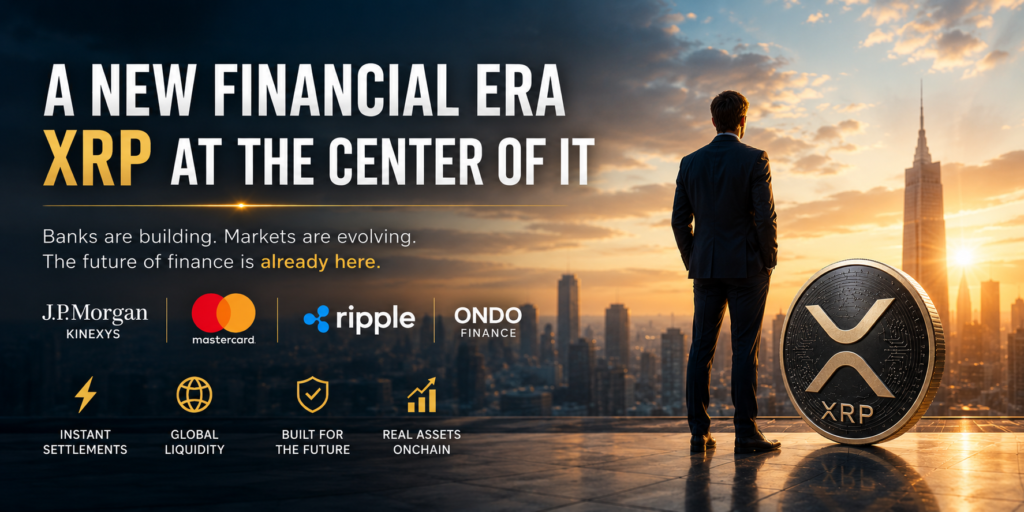
For years, blockchain technology lived in two separate worlds. On one side were crypto enthusiasts promising a financial revolution. On the other were traditional banks and institutional giants dismissing public blockchains as speculative, risky, or simply not ready for serious finance.
That divide is now collapsing.
According to “Coins Millionaire” in a May 2026 YouTube post, a recent groundbreaking pilot involving J P Morgan, Mastercard, and few other financial institutions may become one of the most important moments in the history of blockchain-based finance.
For the first time, tokenized U.S. Treasury assets were settled across borders and across banking systems in near real time using the XRP Ledger infrastructure. This was not a concept demo. It was not a theoretical white paper. It was a live transaction involving real institutions, real money, regulated assets, and one of the largest financial networks on Earth.
And the implications are enormous.
Open a Binnance Crypto Exchange Account for FREE
The Moment Traditional Finance Crossed Into Blockchain Reality
The significance of this development cannot be overstated.
When the largest bank in America quietly integrates with a public blockchain for real-world settlement activity, something fundamental changes. A line that once separated traditional finance from decentralized infrastructure suddenly disappears.
For years, many major financial institutions publicly questioned whether blockchain technology was mature enough for institutional adoption. Yet behind the scenes, the same institutions were building, testing, and preparing for exactly this future.
Now the testing phase is beginning to evolve into operational reality.
The pilot transaction brought together four powerful players:
Together, they executed a cross-border settlement involving tokenized U.S. Treasury bills on the XRP Ledger.
That alone is historic.
But what makes it revolutionary is how seamlessly traditional banking infrastructure interacted with blockchain-based assets in a single transaction flow.
How the XRP Ledger Pilot Actually Worked
To understand why this matters, it helps to break down the architecture of the transaction itself.
The process involved several interconnected layers working together:
1. Tokenized Treasury Assets on the XRP Ledger
Ondo Finance operates a tokenized treasury product known as OUSG, which represents U.S. Treasury exposure on blockchain infrastructure.
These tokenized treasury assets are backed by institutional-grade financial products associated with funds, giving the transaction a high level of credibility and regulatory familiarity.
The XRP Ledger served as the blockchain layer where these assets existed and moved.
2. Mastercard Managed the Messaging Layer
Mastercard used its Multi-Token Network to route payment instructions between participants.
This is critically important because it demonstrates that established payment giants are not resisting blockchain integration anymore. Instead, they are actively building the infrastructure needed to connect traditional finance with tokenized assets.
Mastercard essentially acted as the coordination and communication layer between banking systems and blockchain infrastructure.
3. JP Morgan Delivered the Banking Settlement
JP Morgan used its Kinexys settlement infrastructure to process the banking side of the transaction.
U.S. dollars were delivered into Ripple’s Singapore bank account as part of the settlement flow.
That means this was not just an internal experiment. It was a genuine cross-border transaction involving live banking rails and blockchain infrastructure operating together.
Why JP Morgan’s Involvement Changes Everything
JP Morgan’s participation may be the most significant element of the entire story.
This is not a niche fintech startup experimenting with blockchain. JP Morgan processes trillions of dollars in transactions regularly. On peak days, its transaction volumes can exceed $14 trillion.
When an institution operating at that scale integrates with public blockchain infrastructure, it sends a powerful signal to the rest of the financial industry.
The message is simple:
Blockchain infrastructure is no longer viewed as experimental technology. It is becoming institutional financial infrastructure.
Banks that once hesitated now face a different reality. If JP Morgan is comfortable interacting with public blockchain systems for settlement activity, it becomes increasingly difficult for other institutions to argue that the technology is not ready.
The Rise of 24/7 Financial Markets
One of the most transformative aspects of this development is the shift toward always-on financial infrastructure.
Traditional financial systems still operate within restricted banking hours. Markets close. Settlement systems pause on weekends. International transfers can take days due to intermediary processing and cutoff times.
Blockchain changes that model entirely.
The XRP Ledger pilot demonstrated the possibility of:
- Near-instant settlement
- Continuous operation
- Cross-border asset movement
- Reduced counterparty delays
- Lower friction between institutions
In practical terms, this means financial markets may eventually operate more like the internet itself: continuously active, globally connected, and available 24 hours a day.
That transition could reshape how capital moves around the world.
What This Means for XRP
An important clarification is necessary.
In this specific pilot, XRP itself was not directly used as the settlement asset between JPMorgan and Ripple. Instead, the XRP Ledger infrastructure hosted the transaction while RLUSD and tokenized treasury assets played the primary transactional roles.
However, this distinction does not reduce XRP’s long-term significance.
As more institutions begin issuing stablecoins and tokenized assets on the XRP Ledger, a new challenge naturally emerges: interoperability.
Imagine a future where:
- JP Morgan operates its own stablecoin
- Another global bank operates a different stablecoin
- Multiple institutions tokenize various real-world assets
Those institutions will need a neutral bridge asset to facilitate conversions between systems without forcing either side to hold the liabilities of competing banks.
This is precisely the role XRP was designed to perform.
The more assets and institutions operating on the XRP Ledger ecosystem, the greater the demand for efficient bridge liquidity becomes.
Why Tokenization Could Become the Future of Finance
The broader tokenization market is still in its early stages.
Today, billions of dollars in financial assets have already been tokenized across blockchain platforms. But compared to the size of global financial markets, that number remains tiny.
Consider the scale of traditional finance:
- Global equities exceed $100 trillion
- Bond markets are even larger
- Foreign exchange markets process trillions daily
- Real estate, commodities, derivatives, and private credit add enormous additional volume
Tokenization represents the process of bringing these assets onto blockchain infrastructure.
The benefits are substantial:
- Faster settlement
- Greater transparency
- Lower operational costs
- Improved liquidity
- Fractional ownership possibilities
- Reduced intermediary friction
And most importantly, the institutions driving this shift are not fringe players.
Companies such as:
are actively building tokenization infrastructure.
That is why many analysts believe tokenization could become one of the largest structural transformations in modern finance.
Why the XRP Ledger Fits Institutional Finance
The XRP Ledger was built with a different philosophy from many other blockchain networks.
Instead of trying to become a universal platform for every imaginable application, the XRP Ledger focused heavily on:
- Fast settlement
- Low transaction costs
- Asset interoperability
- Cross-border payments
- Foreign exchange efficiency
- Real-world asset tokenization
That specialization may now be turning into a major competitive advantage.
Institutional finance values reliability, speed, cost efficiency, and regulatory compatibility more than experimental complexity.
In many ways, the XRP Ledger’s architecture appears increasingly aligned with what large financial institutions actually need.
Mastercard’s Quietly Powerful Role
One aspect of the pilot that deserves more attention is Mastercard’s involvement.
Its Multi-Token Network acted as the routing and messaging layer connecting participants across the transaction flow.
This matters because Mastercard already has relationships with financial institutions worldwide. Rather than being disrupted by blockchain technology, Mastercard appears determined to position itself as the bridge between traditional banking and tokenized finance.
That strategy could accelerate adoption dramatically.
Why?
Because institutions prefer working with infrastructure providers they already trust.
If blockchain integration happens through existing global networks like Mastercard, adoption barriers become far lower than if entirely new systems had to replace current infrastructure overnight.
Singapore, the UAE, and the Global Expansion of Blockchain Finance
Geography also plays a major role in this story.
The pilot settlement involved Ripple’s Singapore banking operations, highlighting the importance of Asia in the evolution of blockchain finance.
has positioned itself as one of the world’s leading centers for regulated digital asset innovation.
Similarly, has actively developed regulatory frameworks designed to attract blockchain companies and financial innovation.
As more jurisdictions create clear digital asset regulations, institutional participation becomes easier and less risky.
That regulatory clarity is essential for large-scale adoption.
Public Blockchain Transparency Is a Game Changer
One remarkable feature of the XRP Ledger pilot is that blockchain analysts were able to independently verify the transactions on-chain.
This is one of the greatest strengths of public blockchain infrastructure.
In traditional finance, verifying settlement activity often requires multiple intermediaries maintaining separate records that must constantly be reconciled.
Public blockchains work differently.
The ledger itself becomes the shared source of truth.
That means transactions can be:
- Verified publicly
- Audited transparently
- Confirmed independently
- Tracked in real time
For regulators, compliance teams, and institutions, this level of transparency could eventually become a major operational advantage rather than a risk.
The Bigger Picture: Blockchain Is Moving Into the Mainstream
The most important takeaway from this pilot is not merely technological.
It is psychological.
For years, blockchain discussions were dominated by speculation, hype cycles, and debates over cryptocurrency prices.
This pilot shifts the conversation toward infrastructure.
The XRP Ledger is increasingly being viewed not simply as the ecosystem behind a cryptocurrency, but as a functioning layer of institutional financial infrastructure.
That distinction changes everything.
The internet itself followed a similar pattern decades ago. Early debates focused on whether businesses needed websites at all. Eventually, being online became unavoidable.
Tokenization and blockchain-based settlement may follow the same trajectory.
Right now, the financial world appears to be crossing from experimentation into implementation.
And if that transition accelerates, this JPMorgan-Mastercard-Ripple pilot could one day be remembered as one of the moments the future of finance quietly arrived.
References:
Related Resources: