
Affiliate Disclosure: Some links in this post are affiliate links, meaning I may earn a commission if you make a purchase through them, at no extra cost to you.
Introduction: Why XRP Is Back in the Spotlight
Over the past decade, few cryptocurrencies have sparked as much debate—and quiet institutional interest—as XRP, the digital asset associated with Ripple. Once overshadowed by regulatory battles and market volatility, XRP has re-emerged in 2025–2026 with renewed momentum driven by legal clarity, ETF adoption, and real-world financial integration.
Today, XRP sits at the intersection of global finance transformation: cross-border payments, asset tokenization, and institutional crypto adoption. Some analysts see it as a practical infrastructure tool. Others call it a once-in-a-generation opportunity—a “hidden gold.”
But how much of this narrative is grounded in reality?
This article explores XRP objectively—its real use cases, current developments, projected future roles, and the controversial claims of $10,000+ price targets.
What Is XRP and How Does It Work?
XRP is a digital asset designed to function as a bridge currency for fast, low-cost international payments.
Unlike Bitcoin, which focuses on decentralization and store of value, XRP was built for speed and utility in financial systems. It powers the XRP Ledger (XRPL), a blockchain optimized for:
- Fast transactions (3–5 seconds)
- Extremely low fees
- High throughput for institutional use
The Bridge Currency Concept
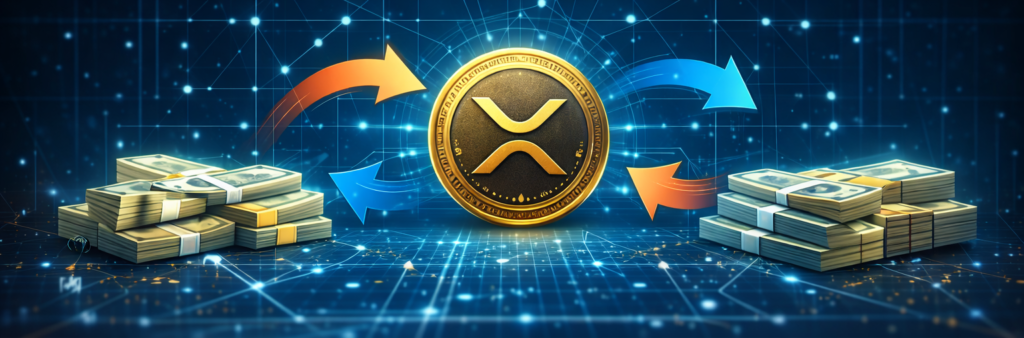
At the core of XRP’s value proposition is On-Demand Liquidity (ODL)—a system that allows banks and payment providers to:
- Convert fiat currency (e.g., USD → XRP)
- Transfer XRP globally instantly
- Convert XRP into another fiat (e.g., EUR)
This eliminates the need for pre-funded accounts (nostro/vostro), a major inefficiency in global banking.
XRP’s intended role:
A neutral liquidity layer connecting all currencies worldwide.
According to current analysis, XRP is already being used as a bridge asset in certain payment corridors, and its future depends heavily on broader adoption by financial institutions. (MEXC)
Institutional Adoption: ETFs and Regulatory Breakthroughs
One of the biggest turning points for XRP came after its long legal battle with regulators ended in 2025.
Key Developments:
- XRP officially classified as a digital commodity
- Spot XRP ETFs launched (Nov 2025)
- Over $1.4 billion in ETF inflows within months (24/7 Wall St.)
- Increased institutional participation (banks, hedge funds)
This matters because ETFs:
- Open XRP to traditional investors
- Reduce circulating supply through locked holdings
- Increase legitimacy in global markets
However, ETF flows have shown volatility—strong initial inflows followed by slower momentum—highlighting that institutional demand is still developing, not guaranteed. (24/7 Wall St.)
XRP and Tokenization: The Real Game-Changer
The Rise of Tokenized Assets
Tokenization refers to converting real-world assets—like:
- Real estate
- Stocks
- Bonds
- Funds
…into digital tokens on a blockchain .
This is where XRP could play a massive long-term role.
Current Progress
- XRP Ledger already hosts billions in tokenized assets (~$2.3B as of 2026) (Yahoo Finance)
- Ripple is partnering with institutions like Aviva Investors to tokenize funds (FNLondon)
- The global tokenization market could reach $18.9 trillion by 2033
Why XRP Matters Here
XRPL offers:
- Built-in tokenization features
- Fast settlement
- Regulatory-friendly infrastructure
If tokenization scales globally, XRP could:
- Facilitate liquidity between tokenized assets
- Act as a settlement layer for digital securities
The $100 Trillion Narrative: Fact vs Hype
You may have seen claims that XRP could absorb $100 trillion+ in global value. Let’s break this down.
Where the Number Comes From
It combines multiple global markets:
- Cross-border payments (~$150T annually)
- Tokenized assets (projected tens of trillions)
- Derivatives and securities markets
Reality Check
While these markets are real, XRP capturing even a fraction is uncertain:
- Banks can use Ripple’s network without using XRP
- Stablecoins are strong competitors
- Other blockchains (Ethereum, Solana) dominate tokenization
Even bullish analysts note that XRP must prove actual usage at scale, not just partnerships.
Conclusion:
The $100 trillion figure is theoretical—not guaranteed capital flowing into XRP.
Price Predictions: Could XRP Reach $10,000?
This is where narratives diverge dramatically.
Realistic Analyst Ranges (2026–2030)
- Conservative: $0.50 – $1
- Moderate: $4 – $10
- Bullish institutional: $20 – $30
- Extreme outlier: up to $1,000
Why $10,000 Is Highly Unlikely (Short-Term)
At $10,000 per XRP:
- Market cap would exceed $600 trillion
- That’s larger than the entire global financial system
Even the $1,000 scenario implies a $61 trillion market cap, which most analysts consider unrealistic in the near term.
What Would Need to Happen?
For extreme price levels:
- XRP becomes dominant global settlement layer
- Massive institutional adoption
- Trillions in daily transaction volume
- Limited competition from stablecoins
These conditions are possible but extremely unlikely in the near-to-mid term.
Geopolitics: War, Currency Instability & XRP
Global tensions—such as ongoing geopolitical friction involving the U.S. and Iran—can indirectly affect crypto markets.
Potential Effects:
- Currency instability → increased demand for alternative systems
- Sanctions → push toward decentralized payment rails
- Capital flight → crypto adoption rises
XRP could benefit in scenarios where:
- Traditional banking systems are restricted
- Cross-border transfers become difficult
However:
- Bitcoin and stablecoins currently dominate this narrative
- XRP’s institutional ties may limit its use in sanction-heavy environments
Geopolitics is a secondary catalyst, not a primary driver.
The Bull Case: Why XRP Could Still Surge
XRP’s strongest arguments are grounded in utility and infrastructure:
1. Real-World Use Case
Unlike many cryptocurrencies, XRP:
- Is already used in payment systems
- Targets a multi-trillion-dollar industry
2. Regulatory Clarity
- One of the few major tokens with legal certainty in the U.S.
3. Institutional Integration
- ETFs, partnerships, and banking connections
4. Tokenization Tailwinds
- Potential exposure to trillions in digital assets
The Bear Case: Risks Investors Must Understand
1. Adoption Gap
Narrative ≠ actual usage
Banks may not use XRP directly.
2. Competition
- Stablecoins (USDC, USDT)
- Ethereum and other smart contract platforms
3. Market Cap Constraints
Extreme price predictions ignore basic economics
4. Volatility
XRP remains highly sensitive to:
- Bitcoin trends
- Market cycles
Final Verdict: Is XRP a “Hidden Gold”?
XRP is not a scam, nor is it a guaranteed path to wealth.
It is:
✔ A legitimate financial infrastructure project
✔ Positioned in cross-border payments and tokenization
✔ Backed by growing institutional interest
But also:
⚠ Dependent on real adoption—not just partnerships
⚠ Facing strong competition
⚠ Unlikely to reach extreme price targets like $10,000 anytime soon
Conclusion: A Strategic Opportunity—Not a Guaranteed Jackpot
XRP may not turn small investments into overnight millions—but it could still deliver meaningful returns if:
- Tokenization accelerates globally
- XRP becomes widely used as a bridge currency
- Institutional adoption continues to grow
In realistic scenarios, XRP represents:
A high-upside, moderate-risk asset tied to financial infrastructure evolution
Not quite “hidden gold”—
…but possibly a strategic metal in the foundation of future finance.